The ispru year: a harvest calendar of Chitral and Gilgit-Baltistan
A season-by-season calendar of Chitral and Gilgit-Baltistan, from spring apricot blossom to summer drying, autumn walnuts and winter weaving on the loom.
4 min read
On this page
In the valleys of Chitral and Gilgit-Baltistan, the year is not really counted in months. It is counted in what is happening on the trees, on the roofs and on the loom. Each season has its work, and each piece of work makes something that will see a household through to the next.
We follow the same calendar. Everything we sell belongs to a season, and some things are only ready at certain times of year. Here is how the year goes in the mountains. The exact timing changes from valley to valley and from year to year, because higher villages always run a little behind lower ones.
Spring: ispru, the blossom
The year begins with the apricot blossom, from late March. Almost overnight, the orchards turn pink and white, and the colour climbs the valley as the season moves uphill.
In Khowar, the language of Chitral, the blossom is ispru, and that is where our name comes from. It is a hopeful time. Snow still sits on the peaks, but the days are lengthening, and the fields and orchards are being readied for the year ahead.
For us, spring is a time of waiting. The blossom tells you what kind of harvest might come, but a late frost or a cold wind can still change everything.
Summer: the apricot harvest
By summer, the zhuli (apricots) are ripe. They are picked by hand, often by families working together, and eaten fresh for a few short weeks. Fresh apricots do not keep, so much of the harvest goes straight to drying.
Late summer: drying on the roofs
Through the late summer, the flat roofs of the villages are covered with fruit drying in the sun. Apricots are laid out whole to become chambor (whole dried apricots), or halved and stoned. They are turned, watched, covered if rain threatens, and brought in when they are dry all the way through.
This is when the year's dried apricots are made. Chambor dried now will be eaten all winter, and it is what we sell through the rest of the year. You can read the full story in from blossom to chambor.
Autumn: walnuts, apples, pears and mulberries
Autumn brings the rest of the orchard harvest, through September and October. The walnut trees are ready, and the birmogh (walnut) harvest begins. The nuts are knocked down with long poles, husked, dried in their shells and later cracked by hand.
Apples are usually picked in September, and the orchards give pears too. Dried, they become palogh (dried apples) and tong (dried pears). Walnuts and mulberries come together in kelawo, the Hunza candy: walnuts threaded and dipped in thickened mulberry syrup.
By the end of autumn, the store rooms are full and the valleys are ready for winter. Read more about the walnut harvest in walnuts of the north.
Winter: the loom
When the snow comes, the high passes close and the fields rest. This is the season of wool. Through the long, cold months, wool is spun by hand and woven on hand looms into shu (handspun wool cloth, called Chitrali patti).
From that cloth come the shoqa (Chitrali wool robe), waistcoats, jackets, shawls and the phakol (the Chitrali wool cap). The season is slow, but far from idle. Much of what keeps the valleys warm, and much of what we sell, is made in these months. Read more in what Chitrali patti is.
Why we follow the seasons
Working with the seasons means working in small batches. When the year's chambor is gone, there is no more until the next harvest. When the winter's cloth has been cut and sewn, we wait for the next winter's weaving.
That can mean some things are out of stock for part of the year. We would rather that than sell old stock, or something that was not made the way we say it was. If something you want has sold out, message us on WhatsApp and we will let you know when the next batch is expected.
It also means that what you buy carries the year with it. A shawl was woven through a particular winter. A jar of chambor was dried in a particular summer's sun. We think that is worth knowing.
From the valleys
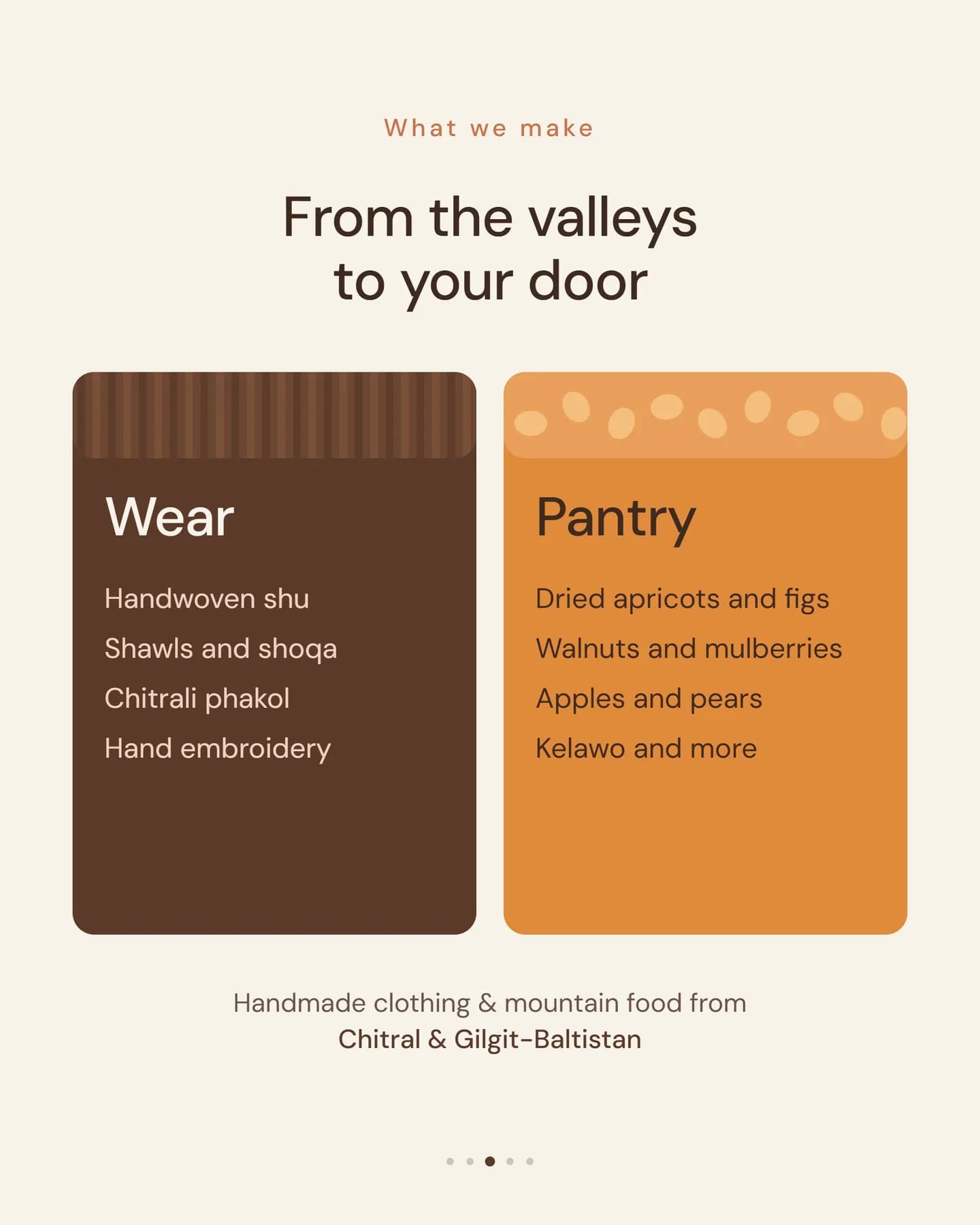
Each season has its place in our shop. From summer and autumn come chambor, birmogh kernels, palogh, tong and the rest of our dry fruits. From winter come our patti shawls and the rest of our Chitrali wear. To taste a little of the whole year at once, try the taste of the north sampler.