Walnuts of the north: desi vs imported kernels, freshness and storage
Desi or imported akhrot giri? How walnut kernels from Chitral and Gilgit-Baltistan differ, how to tell if walnuts are fresh, and how to store them well.
4 min read
On this page
In autumn, the old walnut trees of Chitral and Gilgit-Baltistan drop their nuts, and for a few weeks the villages are busy with knocking, gathering and cracking. In Khowar the walnut is birmogh. In Urdu, shelled walnuts are sold as akhrot giri (walnut kernels).
If you buy akhrot giri in Pakistan, you will usually be offered two kinds: desi and imported. This guide explains the difference, why freshness matters so much, and how to store walnuts so they stay sweet.
Walnut trees in the valleys
Walnut trees have grown in the villages of the north for a very long time. Many are large, old trees standing at the edges of fields, beside streams and near houses. In Chitral and the neighbouring districts, most walnut trees grew from seed rather than being grafted, so each tree is a little different, and so are its nuts.
The harvest comes in autumn, in September and October. The nuts are knocked down from the branches with long poles and gathered by hand, and the green outer husks are removed. The nuts are then dried in their shells before being cracked and sorted, usually by hand.
Desi and imported: what is the difference
Desi walnuts are grown locally, in Pakistan. In the north they come mostly from village trees like these. Because the trees vary, desi nuts vary too. Some are small and some large. Some have thin shells that crack easily, and some have hard shells that need a hammer. Thin-shelled walnuts are known as kaghzi (paper-shell) walnuts, and they are much in demand.
Imported walnuts are grown in orchards abroad. Even in Chitral's own bazaar, walnuts from China have begun to compete with local ones, and they are larger and cheaper. Their kernels tend to be uniform: large, pale halves, all much the same size and colour.
Neither kind is automatically better. Imported kernels look very even, which some people like. Desi kernels look more varied, often with more pieces among the halves, and their skin can range from pale gold to light brown. To us, good desi kernels taste rich and sweet, with a gentle bitterness in the skin, but taste is personal.
What matters most, for both kinds, is how fresh they are.
Why freshness matters
Walnuts contain a lot of natural fats, which is what gives them their soft, rich taste. Those fats can turn rancid over time, especially when kernels are exposed to warmth, light and air.
A rancid walnut tastes bitter and sharp, and can smell a little like paint or old cooking oil. Kernels that have sat in a warm shop or a hot warehouse can turn this way well before their date. Walnuts in the shell are better protected, so they keep for longer than shelled kernels.
This is why old stock is such a common disappointment with walnuts. A kernel can look perfectly good and still taste stale.
How to check walnut kernels
When you buy walnuts, use your eyes, nose and tongue.
- Look. Kernels should be clean and dry, with no dust, webbing, holes or mould. Colour varies naturally, but very dark, greasy-looking kernels are a warning sign.
- Smell. Fresh walnuts smell mild and nutty. A sharp, sour or paint-like smell means they have gone rancid.
- Feel. Fresh kernels are crisp and snap cleanly. Soft, rubbery kernels have picked up moisture or are old.
- Taste. Try one if you can. A fresh walnut is sweet, with a slight bitterness from the skin. A rancid one is unpleasantly bitter, and the taste lingers.
If a bag fails any of these, it is not worth eating, whatever it cost.
How to store walnuts
Cool, dark and airtight is the rule.
- In the fridge, in a sealed jar or container, shelled walnuts keep well for around three months, and often longer.
- In the freezer, they keep for longer still. You do not need to thaw them before baking.
- In the cupboard, keep only what you will eat within a few weeks, and only if the room stays cool.
- In the shell, store whole walnuts in a cool, dry, airy place, and crack them as you need them.
Walnuts take up strong smells easily, so keep them sealed and away from onions, spices and anything strongly scented. Buy in amounts you will eat, and take out only what you need each time, so the rest stays cold.
Ways to enjoy them
In Chitral, walnuts are often eaten with chambor (whole dried apricots), a piece of each together. They are good on their own, with tea, chopped over porridge or yoghurt, or toasted lightly in a dry pan to deepen their flavour. Let toasted walnuts cool before you store them, or they will sweat in the jar.
Walnuts are also the heart of kelawo, the Hunza candy made by dipping walnuts in mulberry syrup. Read about it in kelawo, the Hunza candy, or try our recipe for walnut cake with birmogh.
From the valleys
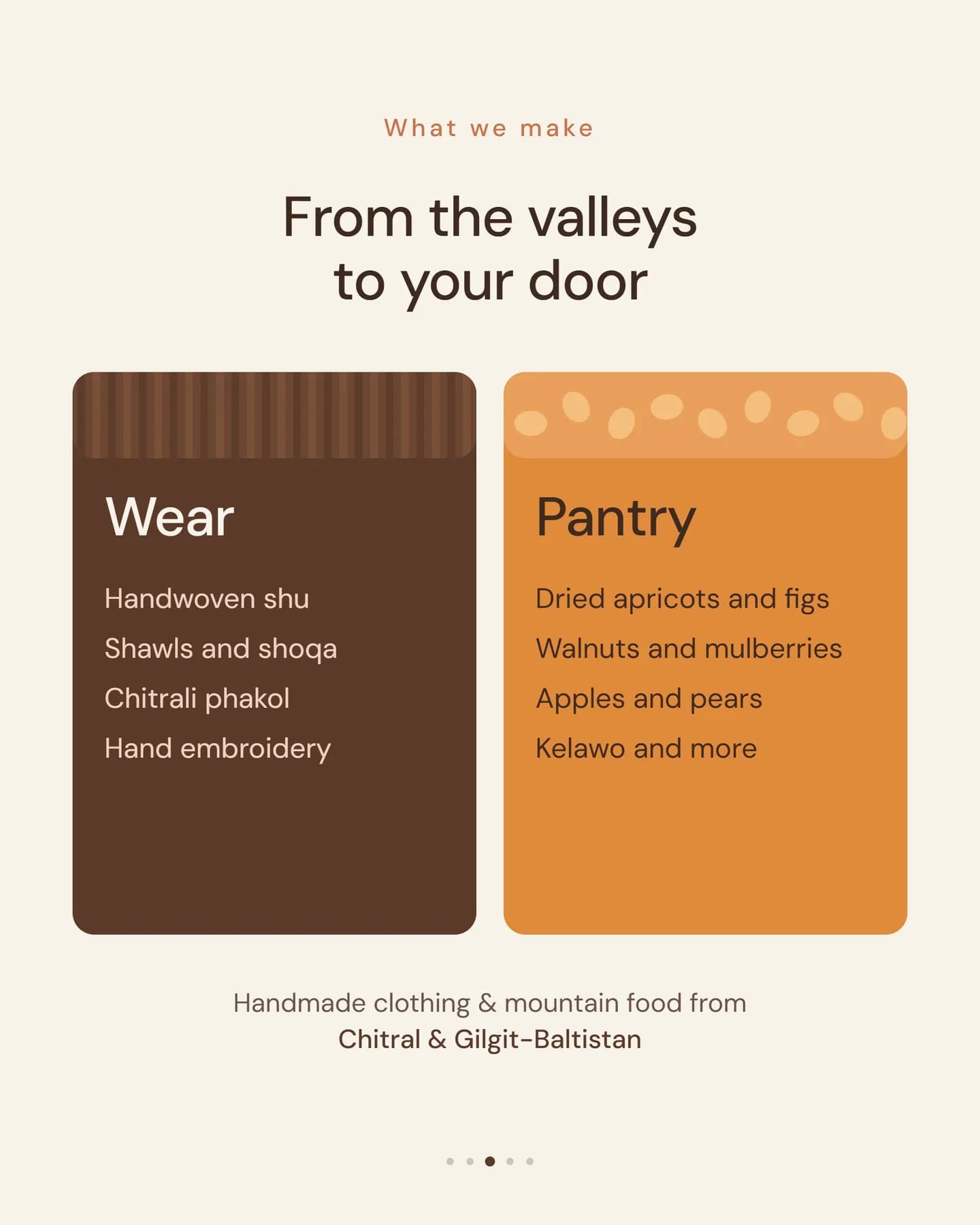
Our birmogh kernels are walnuts from Chitral. You can find them in walnuts, alongside our kelawo. For the way Chitral often eats them, add a bag of chambor.